
MAX has extended its Series B3 round to $29 million, and the use of the money reveals where the real electric-mobility bottleneck sits: not only in the vehicle, but in the energy network around it.
Climate investor Nithio announced its investment on October 12, saying the financing will support MAX’s expansion of cleaner commercial mobility across Africa. MAX combines electric two-wheelers with financing, IoT fleet management, charging and battery subscriptions.
For a commercial rider, that bundle matters more than the novelty of an electric motorcycle. The vehicle only earns money when it can stay on the road.
Charging time is lost income
A private car owner can sometimes wait several hours for a battery to recharge. A motorcycle taxi rider cannot treat that downtime casually.
Commercial riders earn by completing trips. Every hour spent parked at a charger can reduce daily income, particularly in cities where motorcycles and tricycles are used intensively for passenger transport and delivery.
Battery swapping changes the operating model. Instead of charging the entire vehicle, a rider exchanges a depleted battery for a charged one and returns to work.
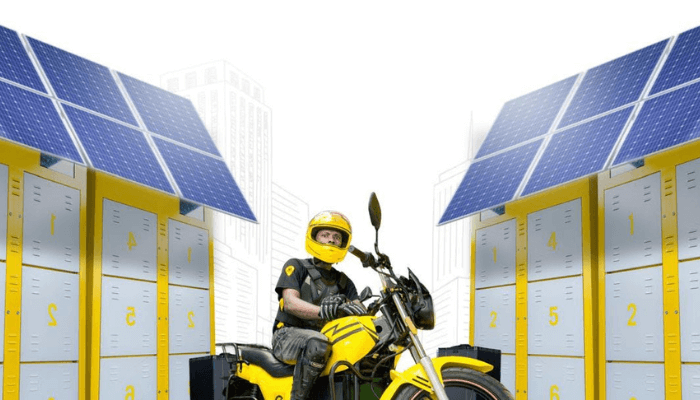
MAX’s electric-vehicle platform says it is building swap stations along key routes and expanding charging infrastructure to support its fleet. The company has also built solar-powered stations, an important adaptation in a country where grid supply can be unreliable.
The infrastructure becomes part of the product promise: energy should be available when the rider needs it.
Financing and energy have to work together
Electric motorcycles still carry a higher upfront cost than many commercial riders can afford.
MAX addresses that through subscription and asset-finance structures rather than asking the rider to buy the vehicle outright. Nithio describes the model as a combination of fleet and battery design, financing, energy and digital operations.
That vertical integration is deliberate. Financing a vehicle without ensuring access to batteries creates repayment risk because the rider’s income depends on uptime. Building swap stations without enough financed vehicles creates underused infrastructure.
The two sides need to grow together.
Nigeria’s broader EV market shows why. Reuters reported in August that weak electricity supply and limited public charging remain major constraints, while two- and three-wheelers are among the more promising segments because battery swapping can reduce charging delays.
Infrastructure can become the moat
Electric motorcycles themselves will become easier to source as more manufacturers enter African markets.
The harder asset to replicate may be a dense, reliable energy network with locations riders already use. Swap cabinets need power, batteries, maintenance, software and enough inventory to handle peak demand.
Once a company has that network, it can potentially support vehicles from multiple manufacturing partners. MAX already works with external vehicle and battery suppliers rather than relying on one proprietary motorcycle.
That turns the company from a vehicle financier into a mobility infrastructure operator.
It also makes execution more capital intensive. Batteries tie up cash. Stations need land and power. Poor utilisation can make each location uneconomic.
Why it matters
Africa’s EV conversation often focuses on vehicle prices and import policy. Commercial mobility exposes another constraint more clearly: energy availability.
For motorcycle taxis and delivery riders, electric transport only wins if the total operating model is better than petrol. That means lower running costs, minimal downtime, reliable maintenance and financing that fits daily income.
MAX’s strategy bundles those requirements instead of treating them as separate markets.
The approach could become especially important as fuel prices remain volatile. An EV does not need to be fashionable to win a commercial rider. It needs to improve earnings.
What to watch
Watch how quickly MAX expands battery-swap coverage relative to the number of electric vehicles it finances. Too few stations create rider frustration; too many create idle capital.
Also watch the share of station energy supplied by solar and other reliable sources. Nigeria’s grid constraints mean the cleanliness and economics of an EV network depend partly on how its batteries are charged.
The $29 million round gives MAX more capital to scale. The harder test is whether every new vehicle arrives with enough infrastructure around it to stay productive.