

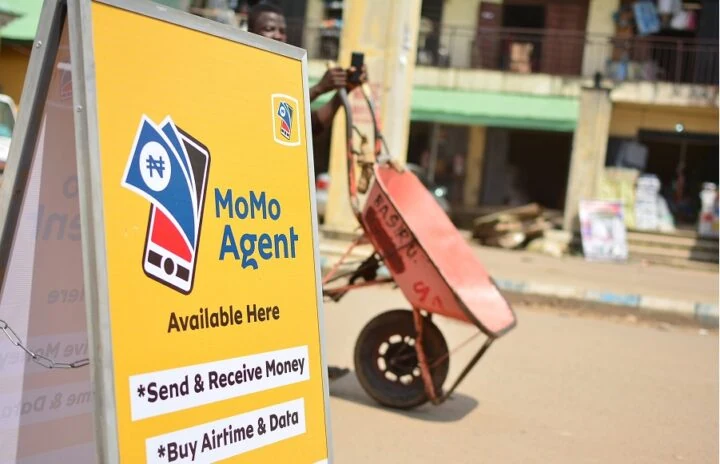

At its capital markets day, MTN Group Fintech chief executive Serigne Dioum told investors the company intends to seek licences that let it lend directly to customers and deploy its own balance sheet, moving beyond its current role facilitating loans through bank partners. Strip away the framing about expanding credit access and the substantive change is precise and consequential: MTN wants to move from distributor to lender, and that shifts where the risk sits.
The signals that matter
The numbers underneath the ambition are real and disclosed, which is the part worth trusting. MTN Fintech reported roughly $2.8 billion in revenue in 2025, processed more than $500 billion in transaction value across over 23 billion transactions, and works with more than two million merchants and an agent network above 1.4 million. Those are throughput and infrastructure figures, the kind that describe an actual payments business. The company also says more than a million people already take loans through its platforms every day, via partnerships.
Note what MTN is and is not today. It is the rail and the distribution channel; the banks and lenders behind it carry the loans, and the credit risk. Direct lending changes that. As one of the few outlets to state it plainly noted, deploying its own balance sheet would expose MTN to credit risk, tighter regulation, and direct competition with banks and digital lenders.
Interrogating the “underserved market” story
The pitch leans on a familiar number: only about 4 to 5 percent of African adults have access to formal credit, and in Nigeria nearly 80 percent of small businesses lack formal financing, a gap estimated at $236 billion. The need is genuine. But “vast underserved market” is exactly the framing that should prompt a harder question, not a nod. A credit gap that large persists for reasons, thin borrower data, weak collateral, high default risk, that did not vanish because a telco decided to lend. The same data thinness that keeps banks out becomes MTN’s problem the moment the loans are on its books rather than a partner’s.
TechCocoon Intelligence reads this less as financial inclusion and more as vertical integration: MTN capturing the lending margin it currently passes to banks, and accepting the loss risk it currently offloads. That can be a sound business, but it is a different business, with a different risk profile, than running payment rails.
Why the timing tracks
The move follows structural groundwork. In April, MTN Group moved to take a 60 percent stake in MoMo Payment Service Bank and a related fintech entity, part of a separation that brought the parent in as a major investor to cushion fintech losses, and it is open to selling minority stakes to raise capital and expertise. Airtel Africa is pursuing a parallel push to unlock value from Airtel Money. Both telcos are reading the same logic: the payments business is mature, and lending is where the next margin sits.
The honest tension is the one MTN’s own framing skips. Lending against the rich behavioural data of a mobile-money network could genuinely improve underwriting where banks fly blind. Or, deployed at scale and at speed across millions of thin-file borrowers, balance-sheet lending could manufacture exactly the default problem that kept formal credit scarce in the first place. Which of those MTN gets depends entirely on discipline that a capital-markets-day slide cannot demonstrate. The question to carry forward is not how big the credit gap is, but how much of its own capital MTN is willing to lose finding out which borrowers were worth the risk.