
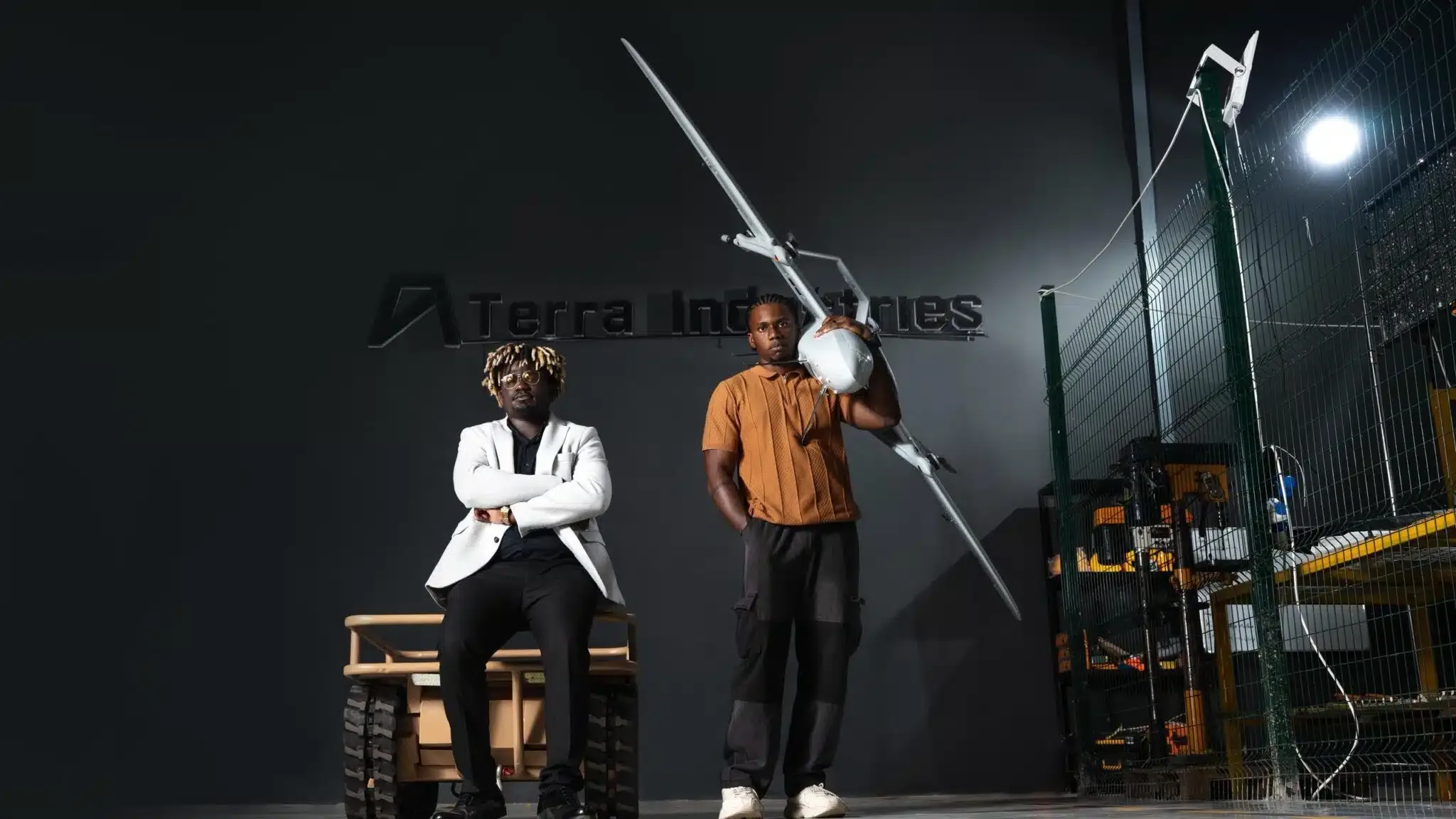
Terra Industries, Africa’s most-funded defence-technology startup, is building a 34,000-square-foot drone factory in Accra that it says will become the continent’s largest when it opens by the end of June 2026. Named Pax-2, it is the company’s first manufacturing site outside Nigeria and more than doubles the footprint of its flagship Pax-1 plant in Abuja.
The plant targets annual output of 50,000 units by 2028 and is expected to create around 120 engineering jobs in Ghana. It will build three of Terra’s aerial systems: the Archer surveillance-and-strike platform, the Iroko tactical UAV, and Kama, a counter-drone interceptor.
Why Ghana
The choice of Ghana over Nigeria is deliberate. Co-founder Nathan Nwachukwu, who started Terra in 2024 with Maxwell Maduka, has framed the move around Ghana’s engineering talent, its location, and a political appetite to become a serious defence exporter. The expansion follows $34 million raised across two 2026 rounds: an $11.75 million round led by 8VC, the firm of Palantir co-founder Joe Lonsdale, and a $22 million follow-on led by Lux Capital, with participation from Flutterwave chief executive Olugbenga Agboola’s Resilience17 Capital.
The Sahel backdrop
The commercial logic sits in a hard security reality. Across the Sahel, armed groups have turned cheap drones into weapons faster than most African militaries can respond. Al-Qaeda’s regional coalition carried out scores of drone operations between 2023 and 2025, and an Islamic State affiliate struck Niamey’s international airport with suicide drones in January 2026. Terra says it already protects roughly $11 billion in assets across eight African countries, including hydropower plants, mines and oil facilities.
The bigger test
Terra’s model borrows from US defence primes Anduril and Palantir: it sells hardware bundled with its proprietary ArtemisOS software on a recurring-fee basis, rather than one-off equipment sales. That is a bet on building a sovereign African defence-industrial base rather than importing it.
The harder question is execution. A 50,000-unit target by 2028 is a steep climb for a company that has generated a few million dollars in revenue so far, and large-scale manufacturing exposes a young firm to supply chains, quality control and government procurement cycles that move slowly. If Terra can convert its funding lead and early contracts into durable demand, Accra becomes more than a factory. It becomes a signal that advanced hardware can be built on the continent, not just bought.