

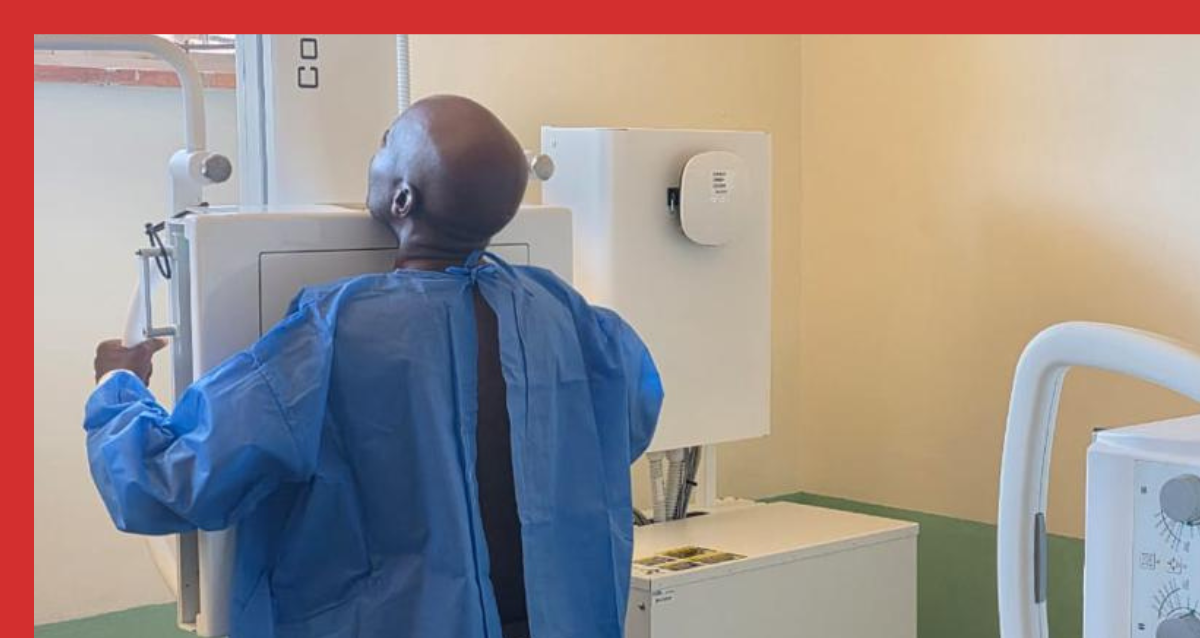

Zimbabwe’s digital health story is moving into one of the places where technology matters most: rural diagnostics.
The country has rolled out digital X-ray machines across 31 health facilities, strengthening diagnostic capacity in communities where patients previously faced slower analogue systems, repeat procedures, or referrals to distant hospitals. The equipment was procured under the COVID-19 Response Mechanism, with support from UNDP and the Global Fund.
This is not the kind of healthtech story that usually attracts the loudest headlines. There is no consumer app, no venture round, and no celebrity founder. But it points to something more important: African digital health will not scale without better physical infrastructure inside the clinics and hospitals where care actually happens.
Rural diagnosis is an access problem
For many rural patients, healthcare access is not only about whether a hospital exists. It is about whether that hospital can diagnose quickly enough to make care useful.
Analogue X-ray systems created real friction. Images had to be developed. Results could be delayed. Poor image quality sometimes meant repeating the procedure. In some cases, patients had to be referred to larger facilities such as Mutare or Bonda Mission Hospital for better diagnostic support.
That adds cost, time, anxiety, and clinical risk.
A patient who needs quick diagnosis should not have to travel long distances because a local facility lacks reliable imaging. A clinician should not have to wait unnecessarily before deciding the next step. A rural hospital should not be forced to operate as a referral point for problems it could solve with the right equipment.
Digital X-ray systems change that equation.
They reduce processing delays, make images available faster, and allow clinicians to review results more efficiently. At Hauna District Hospital, the shift has reportedly doubled patient capacity, with the facility moving from about five to 10 patients to more than 20 patients per day.
That is infrastructure doing what infrastructure should do: shortening the distance between need and care.
The speed difference matters
The operational gain is clear.
At Hauna District Hospital, X-ray operator Benard Kwaramba said the analogue system previously took 15 to 25 minutes to process one X-ray. With the digital machine, the process takes about three minutes.
Previously, using the analogue system, it would take between 15 and 25 minutes to process one X-ray. Now, with the digital machine, it takes about three minutes.
That difference may sound small on paper. It is not.
In a busy rural facility, faster imaging can mean more patients seen in a day, fewer repeat visits, quicker decisions, and less pressure on staff. It can also reduce the need for patients to move between facilities when they are already unwell.
Digital health often gets discussed through national dashboards and electronic medical records. Those systems matter. But in the daily rhythm of a hospital, a faster diagnostic machine can be just as transformative.
Healthtech starts with the room, not the app
The Zimbabwe rollout also shows why digital health depends on basic facility readiness.
To accommodate the shift from analogue to digital systems, health facilities needed electrical upgrades, stronger power supply systems, sockets, and cabling.
That detail matters.
A digital X-ray machine is not just a device. It needs power. It needs safe installation. It needs trained users. It needs maintenance. It needs workflows that allow clinicians to act on the images quickly. If any of those pieces is missing, the technology underperforms.
This is where many digital health projects struggle.
A tool can look impressive during procurement but fail in the field because the facility lacks electricity, connectivity, technical support, spare parts, or trained staff. Real healthtech adoption is not about dropping equipment into a hospital. It is about making sure the hospital can use it every day.
Zimbabwe’s experience is a reminder that the infrastructure around the technology is part of the product.
Why this matters for TB and other conditions
Digital X-ray capacity is especially important for conditions where early diagnosis changes outcomes.
Zimbabwe continues to manage significant public health burdens, including tuberculosis, HIV-related complications, pneumonia, hypertension, diabetes, and other conditions that often require stronger diagnostic support. Rural patients can be especially exposed when diagnostic services are slow or unavailable close to home.
Digital X-ray machines can help clinicians see problems earlier and make faster decisions about referral, treatment, or further testing.
The wider diagnostic value also connects to global health work around TB screening. Delft Imaging, one of the technology providers working in this space, says it delivered 31 multi-functional CompassDR X-ray systems to Zimbabwe’s Ministry of Health in 2023 to strengthen routine TB detection.
That context is important because X-ray access is not a narrow hospital upgrade. It is part of disease detection capacity.
If rural facilities can diagnose more quickly, public health systems become more responsive. Patients also face fewer barriers to care.
The public-private-development link
The rollout shows how health infrastructure often gets built in African markets: through a mix of government leadership, development finance, implementing partners, and technology providers.
Zimbabwe’s Ministry of Health and Child Care procured the machines under the COVID-19 Response Mechanism. UNDP and the Global Fund supported the broader health-system strengthening effort.
That partnership model is not unusual, but it raises a useful question for African healthtech: how do these upgrades become sustainable after the funding cycle?
Diagnostic machines need maintenance. Staff need refresher training. Power systems need reliability. Digital workflows need to be protected. Replacement parts must be available. Data should be handled responsibly. If the equipment becomes unusable after a few years, the system falls back into the same access gap.
Healthtech success should therefore be measured beyond installation.
The better question is whether the machines remain functional, used, maintained, and integrated into routine care.
What startups and operators can learn
This story is not only for government and development agencies. It also carries a lesson for African healthtech founders.
Many healthtech startups are building software: appointment systems, telemedicine platforms, electronic records, pharmacy tools, AI triage, insurance workflows, and patient engagement products. Those products need a functional clinical environment underneath them.
A telemedicine platform is weaker if the local facility cannot diagnose. An AI tool is limited if images are poor or unavailable. A health-record system is less useful if clinical data is incomplete. A referral platform cannot fix the burden of travelling long distances for basic tests.
The strongest healthtech companies will understand the infrastructure reality of care delivery.
That does not mean every startup should buy X-ray machines. It means founders should design around the real conditions of hospitals and clinics: power, connectivity, devices, staff capacity, procurement, maintenance, and patient flow.
The market rewards useful tools. Healthcare punishes tools that ignore context.
The harder test ahead
Zimbabwe’s digital X-ray rollout is a meaningful step, but the work is not finished.
The next questions are practical.
Are the machines consistently operational?
Are rural health workers fully trained to use them?
Are facilities budgeting for maintenance?
Can images be reviewed quickly by clinicians where radiology expertise is limited?
Are power and connectivity stable enough to support continued use?
Are patient waiting times and referral burdens falling across all 31 facilities?
Those are the questions that will show whether the rollout becomes durable infrastructure or a short-term equipment upgrade.
For African healthtech, the implication is clear. Digital transformation in healthcare cannot start and end with software. It must strengthen the clinical systems that patients depend on.
Zimbabwe’s digital X-ray rollout matters because it brings technology closer to the point of care.
That is where African healthtech has to prove itself.