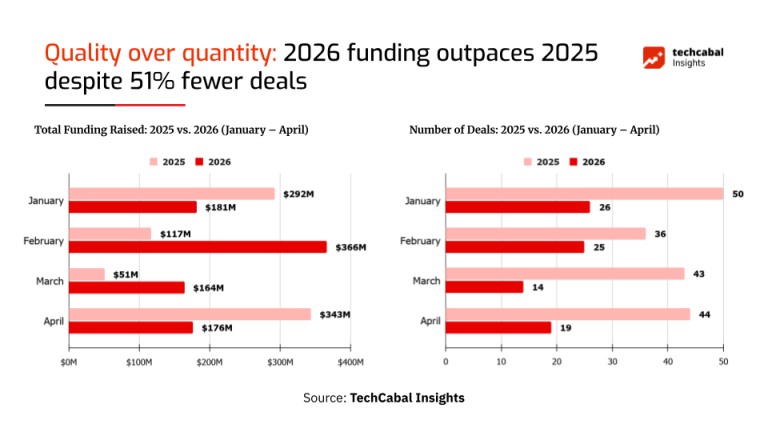

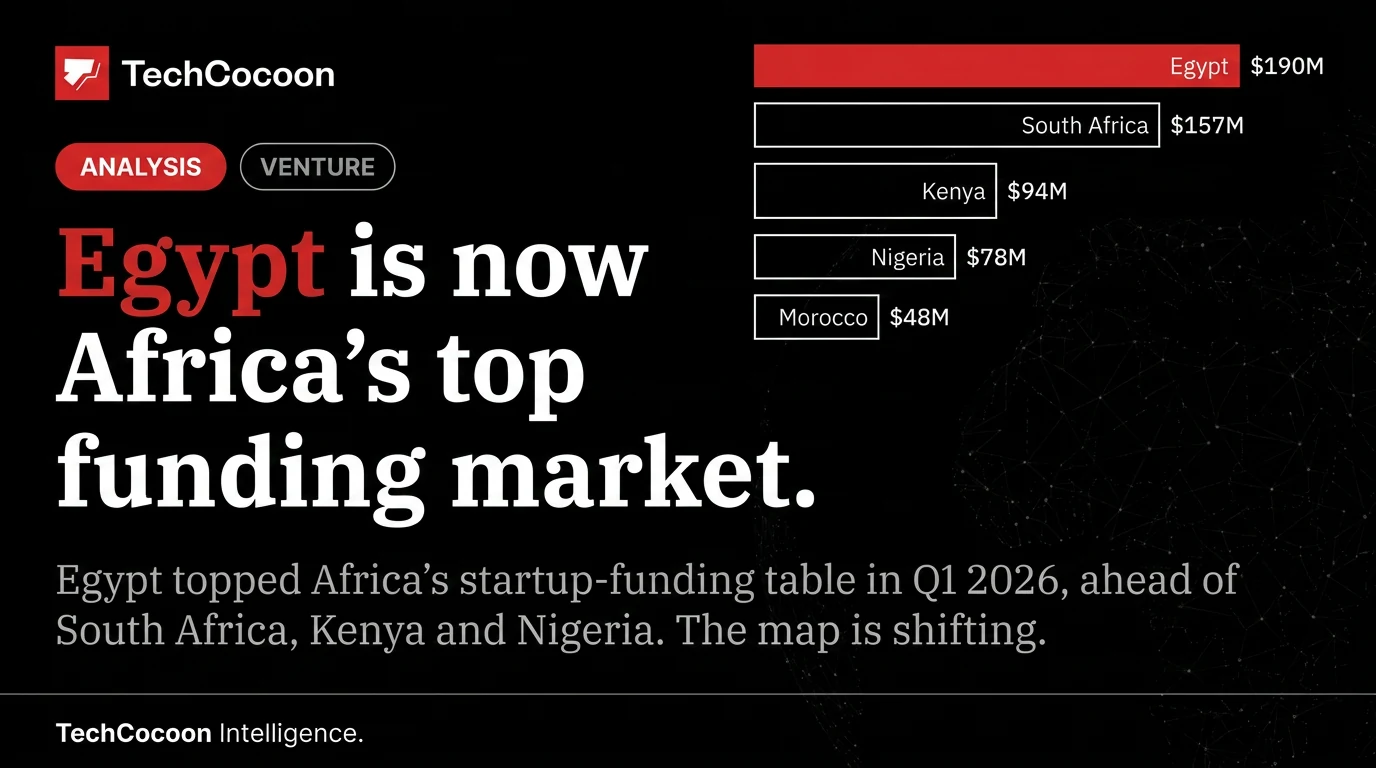
For most of the past decade, the question of which country leads African tech funding had a predictable answer: Nigeria, usually, with Kenya and South Africa trading the next places. The first quarter of 2026 told a different story. African startups raised $705 million across 59 deals in 14 countries, up 26.5% year on year, with Egypt out in front at $190 million, ahead of South Africa at $157 million, Kenya at $94 million, Nigeria at $78 million and Morocco at $48 million.
That ordering, with Nigeria fourth, is the headline. The more useful question is what is driving it, and whether it holds.
Three forces behind Egypt’s rise
The first is scale of demand. Egypt is one of the most populous countries on the continent, with a large, young, urban consumer base concentrated in a handful of cities. That density makes consumer-facing businesses, quick commerce, fintech, logistics, easier to build and scale than in more dispersed markets. Cairo’s quick-commerce company Breadfast is a case in point, having drawn a $50 million round led by Novastar Ventures alongside several Japanese investors.
The second is the pivot of foreign capital. As US and European venture funds pulled back from African early-stage deals through 2025 and into 2026, Gulf and Asian investors leaned in, and Egypt, sitting at the seam of Africa and the Middle East, captured an outsized share of that interest. Egyptian startups increasingly raise from regional funds that view the country as a MENA play as much as an African one.
The third is the maturing of the ecosystem itself. Egypt has produced a deeper bench of repeat founders and later-stage companies than most African markets, which means fewer but larger cheques, the pattern that lifts a country up a funding table even when deal counts stay flat.
The caveats
A single quarter is not a trend, and concentration cuts both ways. Egypt’s lead rests heavily on a few large rounds; strip out the biggest deals and the picture flattens. The country also carries real macro risk. Repeated currency devaluations have battered the pound, which complicates dollar-denominated returns and can make foreign investors cautious even as they chase growth.
There is also the question of breadth. Funding that clusters in Cairo quick commerce and fintech says less about a healthy national ecosystem than about where this quarter’s big cheques happened to land. Nigeria’s lower total, by contrast, sits on top of a wider base of activity that does not always show up in headline dollars.
Why it matters
For founders, the takeaway is that the centre of gravity in African tech is genuinely shifting, not away from Nigeria so much as toward a more multipolar map where Egypt, and increasingly Morocco, matter more than the old Nigeria-Kenya-South Africa shorthand suggests. For investors, Egypt’s rise is a reminder that the next dollar of African venture is as likely to come from Riyadh, Tokyo or Abu Dhabi as from London or San Francisco.
Whether Egypt holds the top spot through 2026 is less important than what its rise signals: African funding is spreading wider and drawing from new pools of capital. The map is being redrawn, and the country that led it this quarter may not be the one most people would have named.