

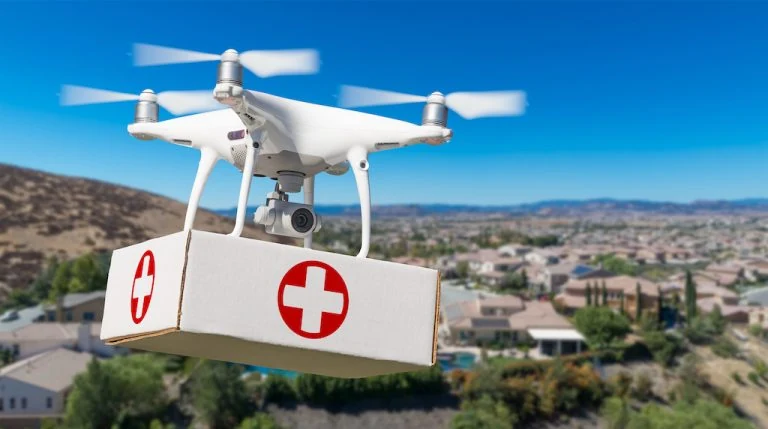

In much of the world, delivery drones are still a futuristic pilot project debated by regulators. In parts of Africa, they are already infrastructure, flying blood, vaccines and medicines to clinics every day. It is one of the clearest examples of the continent leapfrogging a technology rather than waiting for it, and this explainer unpacks how it happened and why it stuck.
The problem drones solved
Start with the geography. In many African countries, a meaningful share of the population lives far from well-stocked health facilities, connected by roads that are poor, seasonal or impassable in the rainy season. For time-critical medical supplies, blood for a haemorrhaging mother, antivenom, vaccines that must stay cold, that distance can be fatal. Stocking every rural clinic with every product is impossible; the items are expensive, perishable and needed unpredictably.
Drones invert the logic. Instead of pushing inventory out to hundreds of clinics and hoping it is there when needed, you centralise stock at a distribution hub and fly the specific item to the specific clinic on demand, in a fixed number of minutes, regardless of the state of the roads. A health worker places an order, and a fixed-wing drone launches, flies to the clinic, and drops the package by parachute.
How it took hold
The breakthrough was operational, not just technological. The model proved itself first in Rwanda, where drone delivery of blood products began in 2016, before expanding to Ghana and other markets, run as a managed logistics service rather than a gadget. The key was partnership with governments and health systems: rather than asking countries to buy drones, operators sold a delivery service, integrated into national supply chains, paid per flight or per contract.
That framing mattered. It made drones a health-system tool, not a novelty, and it aligned incentives, the operator only earns when deliveries happen, so reliability is the business. Newer entrants are extending the idea; Japanese-backed SORA Technology, for instance, has been applying drone technology to health-related work on the continent, a sign that the category is broadening beyond a single pioneer.
The hard parts
Drone logistics is not magic. It is capital-intensive to set up, requiring distribution centres, trained crews and aircraft, and the unit economics only work at sufficient volume across many clinics. Regulation is a constant negotiation: flying beyond the operator’s line of sight, over populated areas, requires airspace permissions that many aviation authorities were not set up to grant, which is part of why Africa, with fewer legacy air-traffic constraints and acute need, moved faster than richer regions.
There are limits of scope, too. Drones excel at small, urgent, high-value payloads, blood, vaccines, lab samples, but they are not a substitute for roads, trucks or the broader health system. They are a precision tool for the last, hardest mile, not a replacement for everything behind it.
Why it matters
The African drone-delivery story is a template worth understanding. It shows the continent adopting a frontier technology ahead of the world, not as a showcase but because the need was acute and the alternative, building roads to every clinic, was slower and costlier. It also shows the right way to deploy hard technology in a health system: as a reliable, integrated service tied to real outcomes, not a pilot chasing headlines. The lesson generalises well beyond drones, and it is one African innovators increasingly take for granted: solve the specific, painful problem, sell the service rather than the gadget, and let the technology disappear into the infrastructure.