
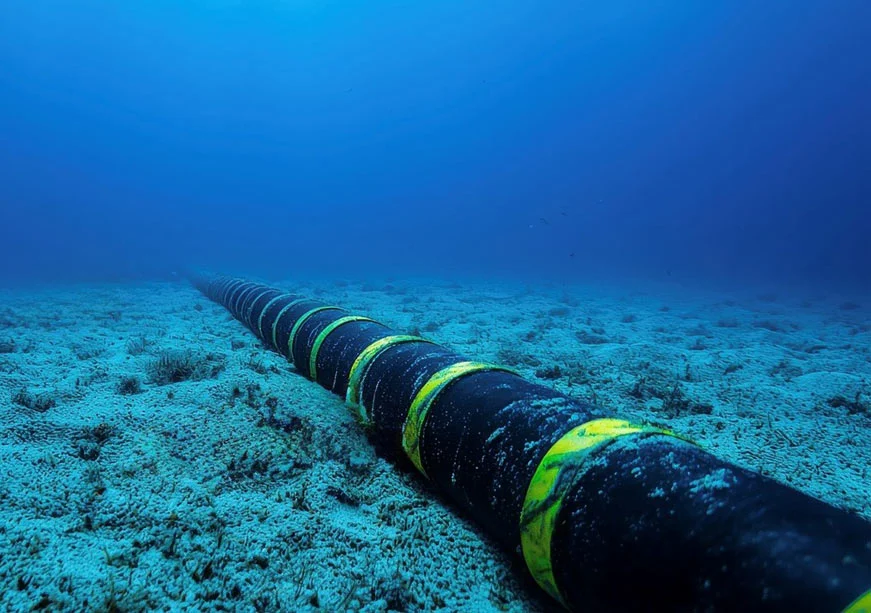

Somalia, Kenya and Tanzania are about to be wired into one of the busiest data routes between Europe and Asia. The European Union has committed €37 million, around $42.8 million, to extend the Blue-Raman submarine cable from its African hub in Djibouti down the coast into East Africa, a move pitched at faster connectivity, cheaper bandwidth, and a larger digital economy across the region.
What Blue-Raman is
Blue-Raman is not a new project, but a significant one. Unveiled in 2021 as a collaboration between Google, the Italian operator Sparkle and other partners, it runs roughly 12,700 kilometres in two segments: the Blue section linking Italy, France, Greece and Israel, and the Raman section running through Jordan, Saudi Arabia, Djibouti, Oman and on to India. Its purpose is to give traffic between Europe and India a route through the Middle East that reduces dependence on older, more congested chokepoints, and it runs on an open-access basis, meaning multiple service providers can use it, which tends to push wholesale prices down.
The East African branch
The new money pays to branch that backbone into East Africa, and it is part of something larger: a €139 million package of digital investments the EU agreed during Kenyan President William Ruto’s visit to Brussels, where he met European Commission Executive Vice-President Henna Virkkunen. For a region where bandwidth has been comparatively expensive and carried by relatively few cables, another high-capacity landing is a concrete gain in both price and resilience, a second or third path for data if one cable is cut.
The politics underneath
The framing around the deal is as telling as the cable. The EU has made the extension a flagship of its Global Gateway strategy, its answer to other powers’ infrastructure financing, and Commission President Ursula von der Leyen cast the project as one that will “connect East Africa to huge digital markets.” Stripped of the language, this is European public money laying physical infrastructure that routes the region’s data through a particular set of partners, part of a wider contest over whose cables and standards carry the world’s traffic.
What it means downstream
For East African users and businesses, the politics matter less than the outcome: more capacity, more redundancy, and downward pressure on the wholesale price of moving data. The open question is whether those wholesale gains reach retail customers, which depends on the operators and regulators downstream, not on the cable itself, since cheaper international bandwidth has a long history of not fully reaching the end user. For the region’s builders, the takeaway is simpler. The rails their products run on are getting fatter and more resilient, and an open-access cable means more providers can compete to sell that capacity on.