
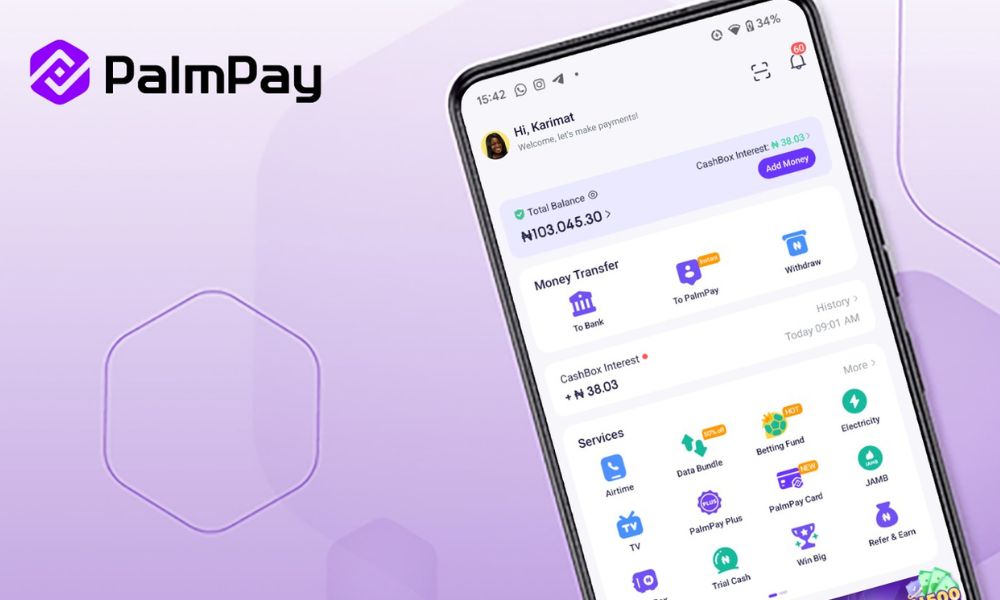

PalmPay’s consumer app may be the visible brand, but its merchant network is what turns a wallet into everyday payment infrastructure.
The company says its business platform has onboarded more than one million businesses and is trusted by hundreds of thousands of merchants. Its POS service offers smart and traditional terminals, instant settlement and additional services such as airtime, data, electricity and television payments.
That expansion reflects a basic fintech reality. Acquiring users is not enough. A wallet becomes more valuable when customers can use it across a dense network of real businesses.
Acceptance creates reasons to keep the wallet
Consumer fintechs often compete first on onboarding, transfers, cashback or bill payments. Those features can generate rapid account growth, but they do not automatically create a durable transaction network.
If customers still need to move money out to another bank or withdraw cash for most purchases, the wallet remains one step removed from commerce.
Merchant acceptance changes that. Each additional business gives customers another reason to leave value inside the network and pay digitally. For PalmPay, POS terminals also create a physical distribution layer that reaches people who may never begin with the app.
The company says its terminals support a range of payment and agency services. That means one merchant can function as both a place to buy goods and a local access point for financial transactions.
In a market where cash and agent banking remain important, that hybrid role matters.
The merchant side needs its own product
A business does not adopt a payment network because a consumer app is popular. It adopts because settlement is reliable, transaction failures are manageable and the economics make sense.
PalmPay advertises a 99% success rate on its POS product and instant settlement. Those are company claims, but they highlight the performance measures merchants actually care about.
Its broader business product says more than 1.1 million businesses have been onboarded and more than 600,000 merchants trust the platform. The figures suggest PalmPay is treating merchant acquisition as a separate growth engine rather than an automatic consequence of consumer adoption.
That approach also produces local distribution. POS operators and merchants can introduce PalmPay services to customers in neighbourhoods where digital-only acquisition would be more expensive.
Network density is more useful than headline downloads
Fintech apps can accumulate registrations through promotions and one-off use. Merchant networks are harder to fake because value depends on repeated local activity.
A dense acceptance network can create a reinforcing loop. More merchants make the wallet more useful to consumers. More active consumers make PalmPay more attractive to merchants. More payment data can then support business services, credit decisions or targeted offers.
But network effects are not guaranteed. Merchants often carry terminals from several providers, and customers can maintain multiple finance apps. PalmPay still has to win the transaction each time.
That makes reliability and pricing more important than exclusivity.
Why it matters
Nigeria’s fintech competition is moving beyond the number of consumer accounts opened.
The stronger question is which platforms become part of daily commerce. Merchant acceptance, settlement and agent distribution determine whether digital balances circulate inside a network or immediately leave it.
PalmPay’s push shows why this matters for wallet companies across Africa. Customer acquisition can create reach, but merchants create utility. Without enough places to pay, a wallet is mostly a transfer interface.
The companies that connect both sides can build a more defensible network because they own relationships with consumers and businesses at the same time.
What to watch
Active merchant volume matters more than the number of businesses ever onboarded. Watch transaction frequency, merchant retention and how many POS locations generate consistent activity.
Also watch whether PalmPay turns its merchant footprint into deeper business products such as working capital, inventory tools or more sophisticated account services.
The strategic test is simple: can PalmPay make the merchant network valuable enough that users spend through it, not just sign up for the wallet?