
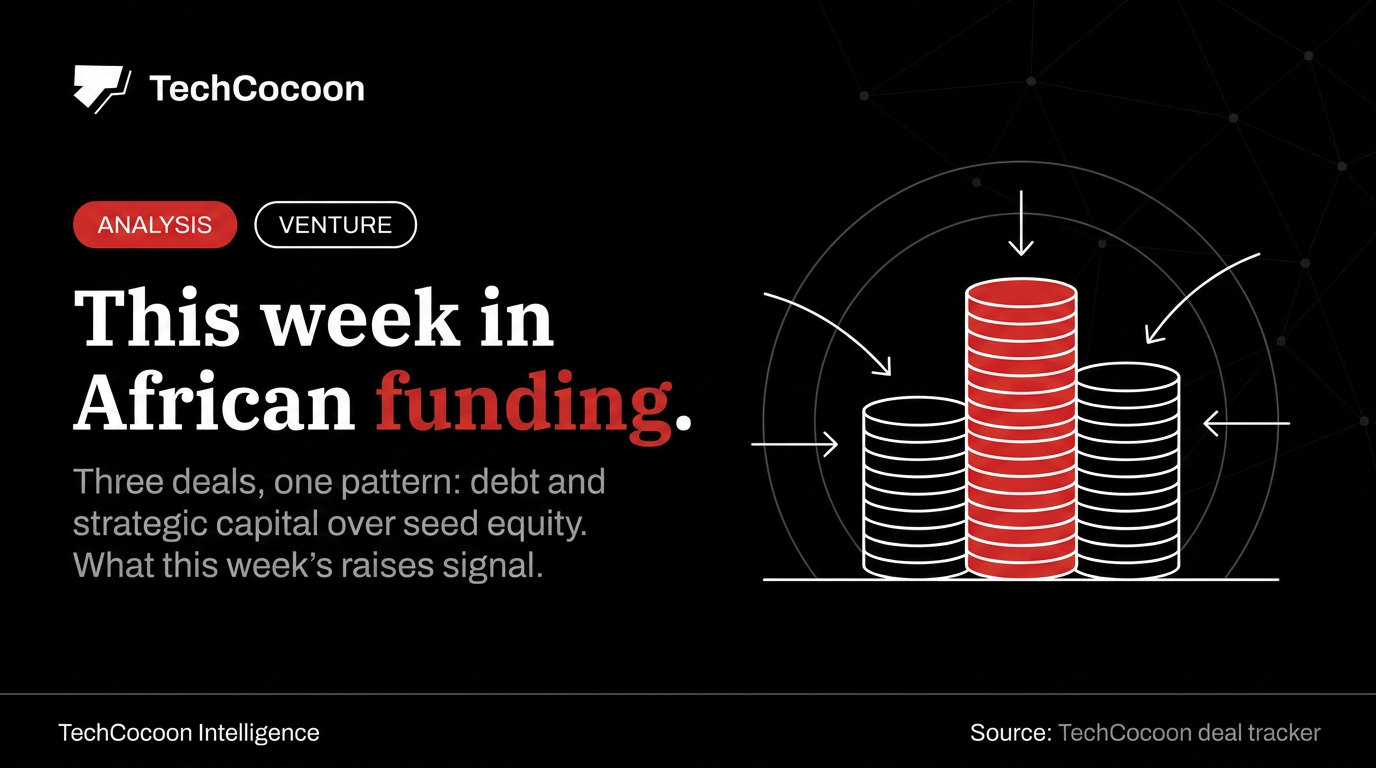
Three funding moves defined the week in African tech: Ripple taking a strategic equity stake in Flutterwave’s Series E at a $3.2-3.3bn valuation, Inspired Evolution launching the $176m Zafiri energy-access vehicle, and Morocco’s EmTech Capital raising a $60m second fund for pre-Series A and Series A startups across four markets. Reported on their own, they look like three unrelated good-news stories. Read together, they describe a single pattern, and it is the pattern that has defined African funding all year.
What the three deals share
None of them is an early-stage equity cheque into an unproven company. The Flutterwave deal is a strategic investor buying a position in the continent’s most valuable fintech, a company with more than a billion transactions and $50bn in processed volume behind it. Zafiri is patient, blended capital aimed at scaling distributed-energy companies that already exist, structured around a first-loss tranche from a development bank. EmTech is raising for pre-Series A and Series A, the stage after the riskiest bet has already been taken.
That is the through-line. Capital this week flowed toward infrastructure, proven scale and the safer end of the stage spectrum. The week’s headlines contained a strategic corporate stake, a permanent-capital energy fund and a Series A vehicle, and not a single seed round among them. This is not a coincidence of one week. It is what the year’s data has been saying.
The data underneath the week
African startup funding has not collapsed in 2026; it has changed shape. More capital has flowed into the ecosystem than in the same period last year, but the composition has shifted hard. Debt and hybrid instruments have overtaken pure equity by volume, accounting for roughly 70% of capital in the first quarter on some counts. Equity at the earliest stages has thinned, deal counts have fallen sharply year-on-year, and seed-stage activity sits at multi-year lows. One tracker described the classic African seed round, the small equity cheque that once seeded a generation of founders, as being quietly euthanised.
TechCocoon Intelligence reads this week’s three deals as expressions of that shift rather than exceptions to it. A strategic investor buying into a $3bn company, a DFI-anchored energy vehicle and a Series A fund are exactly what a market that rewards proof over promise produces. The capital is real and the deals are sound. What is missing from the week, and from the year, is the cheque that takes a chance on a company that has not yet proven anything.
Who this is good for, and who it is not
For a growth-stage company with revenue and assets, this is a good market. Debt is available, strategic investors are writing cheques, and structured finance has matured to the point where a profitable business can raise on terms that do not dilute its founders. The Flutterwave and Zafiri deals both reward exactly that profile, scale, predictable flows, fundable assets.
For a first-time founder raising a first cheque to test product-market fit, the same market is harder than it was a year ago. Debt does nothing for a pre-revenue company with no assets to pledge. A Series A fund, however welcome, does not write seed cheques. And a strategic stake in a unicorn is the opposite end of the pipeline from the founder trying to get started. The capital that is flowing is not the capital the earliest-stage founder needs, and that mismatch is the quiet crisis underneath a year of healthy-looking headline totals.
What to watch next
Two things will tell us whether the pattern holds or breaks. The first is whether the new funds, EmTech’s and the broader pool of more than 250 active vehicles, actually deploy into seed and pre-seed at the pace their mandates suggest, or whether they too drift toward the safer, later, more provable end. The second is whether any of the blended and DFI-anchored vehicles succeed in crowding in the commercial capital they are designed to attract; if they do, the early-stage pool could refill from an unexpected direction.
The open question
This week’s deals were good deals, and the capital behind them is patient, strategic and real. But a funding ecosystem that finances scale, infrastructure and proven companies while starving the founders who have not yet proven anything is building on a pipeline it is no longer feeding. The standing question for the rest of 2026 is whether African tech can rebuild an early-stage capital base, or whether it keeps applauding a rebound that is, underneath, a market quietly narrowing to the companies that already made it.