

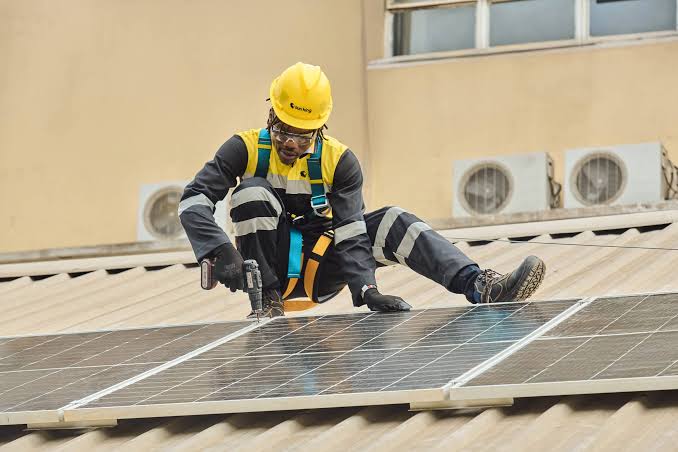
A solar home system may cost a household only a small weekly payment, but millions of those payments can become an institutional financial asset.
Sun King has spent years building that aggregation model. Its EasyBuy programme finances solar products for customers in small instalments, while the company has used securitisation, sustainable debt and other capital-market structures to fund the receivables at scale.
There is another layer in the model: carbon. Sun King’s customer terms in some markets reserve the company’s right to sell, assign or pledge carbon credits created by the solar system. The Africa Carbon Markets Initiative has also profiled a Sun King solar project registered through CarbonClear across multiple African countries.
Put together, the structure shows how thousands of tiny energy assets can be converted into several forms of financeable value.
The customer repayment is the first asset
Pay-as-you-go solar solves an affordability problem by replacing a large upfront purchase with smaller payments over time.
For Sun King, those future instalments create receivables. A large, diversified pool of receivables can then be financed by banks and institutional investors, giving the company capital to deploy more systems before earlier customers finish paying.
That loop has already moved into mainstream finance. Sun King’s 2025 sustainable-finance review says roughly one in three products deployed since 2023 was backed by sustainable-financing instruments.
The company has also used large local-currency facilities, including an $80 million Nigeria debt transaction with IFC and Stanbic IBTC Bank.
The important financial innovation is aggregation. No institutional investor wants to underwrite one household’s lamp. A portfolio of millions of repayment histories is different.
Carbon creates a second stream of value
Replacing kerosene lamps or other fossil-fuel energy sources with verified solar use can avoid greenhouse-gas emissions.
If that impact is measured under an accepted methodology, it can generate carbon credits that companies buy to support climate claims or beyond-value-chain mitigation.
CarbonClear currently lists Sun King Kenya credits among projects available through its platform. The model relies on digital monitoring and third-party verification to link deployed solar systems with emissions reductions.
This revenue can improve project economics, but it is not free money. Carbon markets face scrutiny over additionality, measurement and whether claimed reductions would have occurred anyway. A credible credit must survive those questions.
The ownership clause in Sun King’s customer contracts is therefore important. Carbon value only becomes financeable when it is clear who controls the environmental attribute created by the system.
Distributed energy starts to resemble infrastructure finance
The result is a layered capital stack.
Customers provide repayment cash flows. Lenders finance the receivable pool. Sustainable-debt investors accept instruments linked to climate and social outcomes. Carbon buyers may pay for verified emissions avoidance.
Each layer can reduce the amount of equity Sun King needs to fund every new installation.
That is what turns off-grid solar from a retail-products business into infrastructure finance. The physical systems are distributed across thousands of homes, but the cash flows and impact data are aggregated centrally.
The model also depends heavily on data quality. Investors need repayment performance. Carbon markets need credible measurement. Regulators and customers need transparent contracts.
Why it matters
Africa’s energy-access gap is too large to be funded by grants and venture capital alone.
Off-grid solar needs pools of debt and institutional capital that can recycle as customers repay. Sun King’s financing structures show one way to make household energy legible to those investors.
Carbon revenue can add another source of value, especially where it helps lower customer prices or fund deployment into harder-to-serve markets. But it should remain a supplement to sound unit economics, not a substitute for them.
For climate founders, the larger lesson is that distributed assets become more financeable when their cash flows, ownership rights and impact can be measured consistently.
What to watch
Watch the quality and transparency of Sun King’s carbon-credit issuance, including verification standards, retirement records and how carbon revenue affects customer economics.
Local-currency financing is equally important. Borrowing in dollars to fund customers who repay in naira, shillings or other African currencies creates exchange-rate risk. More domestic-currency structures can make the model more resilient.
The long-term opportunity is larger than solar. If small climate assets can be measured and aggregated reliably, similar financing logic could extend to electric mobility, clean cooking and other distributed infrastructure.