
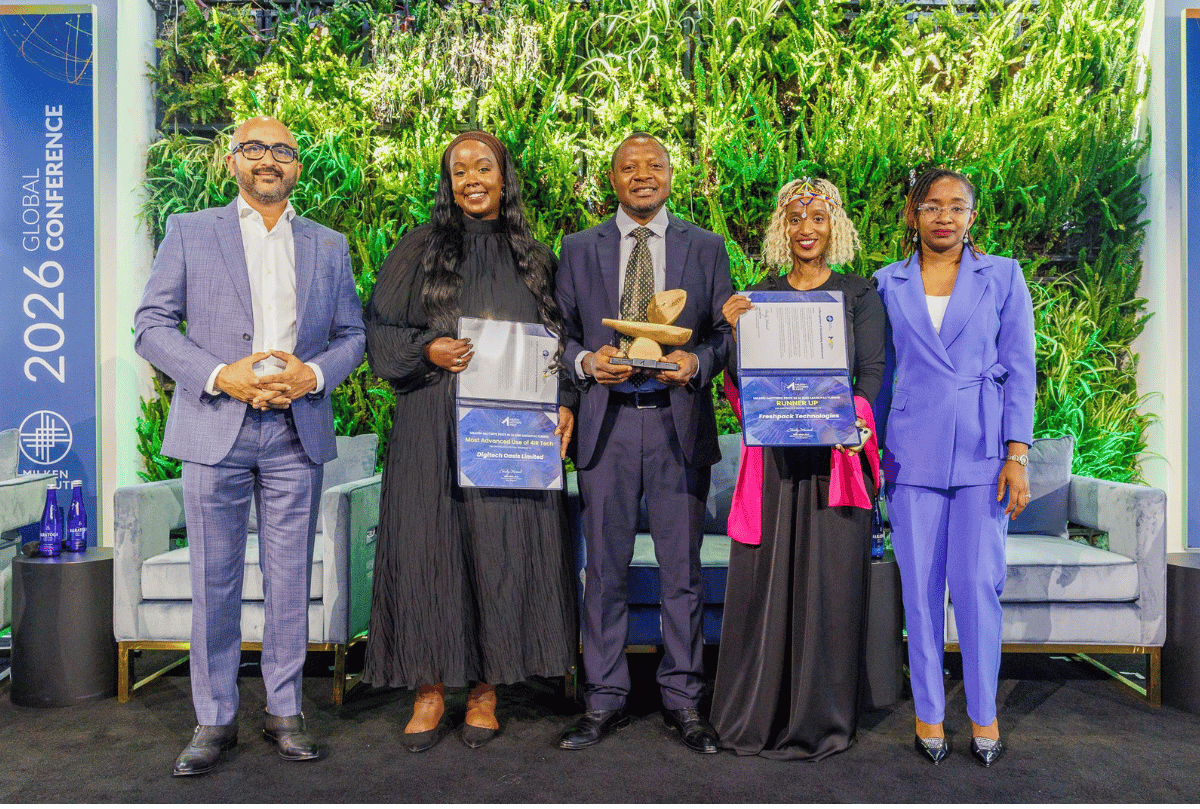
Cameroon’s BleagLee has won the $1 million Milken-Motsepe Prize for an AI-powered waste recycling solution, putting a Central African climate-tech startup into a wider conversation about how artificial intelligence can solve physical infrastructure problems, not only digital ones.
The win matters because Africa’s AI conversation is still heavily shaped by chatbots, model access, productivity tools, and software automation. BleagLee’s work points in a different direction: applied AI for waste sorting, recycling, sanitation, and circular-economy infrastructure. A recent GITEX Future Health Africa update listed BleagLee as the winner of the prize, with the company recognised for an AI-powered waste recycling innovation.
For African tech, that is a useful signal. Some of the continent’s hardest problems are not clean software problems. They sit in streets, markets, landfills, informal recycling systems, municipal budgets, and supply chains that still rely heavily on manual sorting and inconsistent collection.
If AI is going to matter deeply in Africa, it will need to work there too.
Applied AI is where the harder value sits
It is easier to build an AI product that writes text than one that changes how physical waste moves through a city.
Waste management is fragmented in many African markets. Collection is often inconsistent. Sorting is manual. Recycling supply chains can be informal and undercapitalised. Municipal systems are stretched. Data on waste flows is weak. Plastic, organic, electronic, and mixed waste often move through the same messy routes.
That is why automation matters.
An AI-powered recycling system can potentially improve sorting speed, material recognition, operational efficiency, and recovery value. It can help reduce the amount of recyclable material that ends up in landfills. It can also create cleaner input streams for recycling businesses that depend on better-quality recovered material.
The product still has to prove its economics. Prize money does not automatically mean market adoption. But the category is important.
African climate tech cannot only be about carbon dashboards or donor-friendly pilot projects. It has to improve physical systems.
Why the prize matters
The Milken-Motsepe Prize is designed to support entrepreneurs building scalable solutions to major development challenges. A $1 million award gives BleagLee more than visibility. It gives the startup room to refine its product, test deployment, build partnerships, and prove whether its technology can work beyond a controlled demo setting.
For early-stage African climate-tech companies, that kind of non-dilutive capital can be meaningful. Hardware, robotics, and automation are often more expensive to build than software-only products. They require prototypes, field testing, maintenance, components, logistics, and partnerships with municipalities, recyclers, waste aggregators, or industrial users.
That makes funding harder.
Investors often prefer software models with faster iteration cycles and lower upfront costs. Climate hardware startups have to carry more execution risk before their economics become obvious.
BleagLee’s prize win helps bridge part of that gap.
Cameroon is part of the story
Cameroon is not usually the first market named in Africa’s startup funding conversation. That makes this story more important.
African tech coverage often leans heavily toward Nigeria, Kenya, South Africa, and Egypt. Those markets matter, but they do not hold all the interesting innovation. BleagLee’s win shows why TechCocoon should keep watching less-covered markets where founders are building around local constraints that larger ecosystems may overlook.
Central Africa’s technology story is still underreported. Infrastructure gaps, capital scarcity, language fragmentation, and weaker venture visibility can keep strong startups out of the mainstream African tech conversation.
A prize like this does not solve those structural problems. But it can open a door.
It gives BleagLee a stronger platform to attract partners, technical support, follow-on capital, and policy attention. It also helps show other founders in the region that global recognition is possible without relocating the story to a more familiar startup market.
The recycling market needs better infrastructure
Waste recycling is not just an environmental issue. It is an infrastructure and economics issue.
A recycling business needs predictable collection, sorted material, transport, buyers, equipment, and enough margin to make recovery worthwhile. If the supply chain is too fragmented, good intentions collapse into poor unit economics.
This is where technology can help, but only if it fits the system.
AI can identify material types. Sensors can improve sorting. Automation can increase throughput. Data can help cities and recyclers understand waste flows. Digital platforms can connect collectors, processors, and buyers.
But technology alone will not fix the market.
BleagLee will still need partnerships with waste companies, public authorities, recyclers, industrial buyers, or community-based collection networks. It will need deployment sites, maintenance capacity, and a business model that can work in cities where budgets are tight and waste management is often politically sensitive.
That is the real test after the prize.
What African climate-tech founders can learn
BleagLee’s win carries a wider lesson for African climate-tech founders: solve a physical problem, but do not underestimate the operating system around it.
A strong product still needs a path to deployment. A recycling robot needs a place to operate. A sorting system needs material supply. A waste-data platform needs customers who can act on the data. A circular-economy tool needs buyers for recovered materials.
The best climate-tech companies on the continent will not only build clever technology. They will build around the messy realities of African cities.
That means understanding informal workers, municipal incentives, transport costs, maintenance, spare parts, power supply, and how money actually moves through the waste economy.
This is why BleagLee’s category is worth watching. It forces AI out of the abstract and into the difficult work of changing real systems.
The harder test ahead
Winning the $1 million Milken-Motsepe Prize is a strong milestone. The harder test is what happens next.
Can BleagLee turn recognition into repeatable deployments?
Can the technology work in different waste environments?
Can the company reduce sorting costs or increase material recovery enough to justify adoption?
Can it partner with municipalities, recyclers, or industrial buyers without becoming trapped in slow procurement cycles?
Can it build a business model that survives after grant and prize capital?
Those are the questions that matter.
Africa’s climate-tech market needs more companies working on physical infrastructure problems. Waste is one of them. Energy, water, transport, agriculture, and health logistics are others.
BleagLee’s win is encouraging because it shows that African AI can be more than a digital assistant on a screen.
It can be a tool for rebuilding the systems that cities depend on.